Thursday, 19 November 2009

London - 1840s-1914

A Father and Son Partnership (The 1840s)


JOSEPH (b1800) and his son JOHN (b1821) move to Lambeth, a suburb in South London around 1840. They take JOSEPH (b1800)'s youngest children (ROBERT (b circa 1833) and LUCY (b circa 1840)) with them, leaving CHARLES (b circa 1826), HARRY (b circa 1828) and SALLY (b circa1831) all by now of age, in Bury St Edmonds. I haven't followed these lines through but it is likely that there are Gilberts still in Bury St Edmunds that come from this family.


Once in Lambeth, JOHN (b1821) meets and marries a Bethnal Green girl; JANE ELIZABETH REYNOLDS in the Parish Church of St Mary, Lambeth  (.Picture of St Mary's) They marry on 11th July 1841. Her father Charles, also an engineer, may have worked with JOSEPH (b1800) and his engineer son, JOHN (b1821) and witnesses the marriage with a J. L. Gassler. JOHN (b1821) is living in Waterloo Road at the time of his marriage.  Both are of full age, so one assumes 21 years old, although the ages aren't stated.


By the 1851 Census JOSEPH (b1800) and his son JOHN (b 1821) are living opposite each other (at numbers 43 and 44) respectively in Boston Street, Shoreditch, on the north side of the River Thames.  JOSEPH has Mary Ann and their two youngest children and ROBERT (b1833) and LUCY (b1840) living with them.  It's not clear from the copy of the census that I have, but it appears that JOSEPH is 50 and Mary Ann 54 at this time.

By now JOHN (b1821) and Jane have three children JOHN (8?) JOSEPH (b1845) aged 6, and ALFRED (b 1848) aged 3.


 Old Ordnance Survey Map : Shoreditch 1872

JOHN (b1821) also states they are living in Boston Street at Union Mills in 1854 and the Engine Works, Boston Street (1855). One assumes this is the same place but whether they are living there as owners or employees is unknown. Incredibly at the end of the road according to the map of 1872, there is a Brewery.

Boston Street , Shoreditch, London EC2
showing the Brewery at the Hackney Road end,
now site of the Hackney City Farm
 (detail from : Old Ordnance Survey Map : Shoreditch 1872)


I visited the site which is just off Hackney Road.  It is now the Hackney City Farm. Much of the surrounding area was waiting to be re-developed in 1997 so I could get a good feeling of what it must have been like. The street sign for Boston Street was still attached to the wall of a school built in 1873.


According to the City Farm website,

“In the early 1800s the site was occupied by farmers and market gardeners supplying fresh produce to the city of London.


Later as the area became built up, a brewery occupied the site and beer was brewed from late 1880s until the 1930s. West’s brewery as it was then, supplied beer to its own public houses in Hackney Road and nearby Bethnal Green. The water used in the brewing process was supplied by a well, still present today (although capped) in the front garden. “
You can see from the map how, by the 1870s, inner London was typical narrow small terraced housing.  However, I am very curious about Union Mills.  Was this house free for its workers?  Were Joseph and John working for a pre-cursor to the Brewery or did they have their own Engineering works in this area?  I hope to find out more about this in the future.  I suppose I don't want to believe that, from looking through my 21st C eyes, the family went from what seemed
to be a comfortable life in a delightful Norfolk village to 'dark satanic mills', especially when you read the description below:
Shoreditch with its mere 640 acres, had grown faster than any other London parish in the first half of the century and by 1851 it had nearly 130,000 inhabitants. Although the numbers declined thereafter, they did so only slowly. Shoreditch in 1870 was still grossly overcrowded.... Many inhabitants were living in impossibly crowded and airless conditions... The New River Company had not yet provided Shoreditch with a constant water supply......The population was constantly shifting....Those who could afford to, moved away from Shoreditch. Those who came in to replace them, uprooted by other clearances and railway development were those who could afford nothing better.....There were, as there had been for decades, public houses galore.” (Old Ordnance Survey Map: Shoreditch 1872)

The Inventor ( The 1850s)


My grandfather (ALBERT EDWARD Gilbert (1904-1998) remembers his great-grandfather (JOHN b 1821) as
“a man of sub-stature, with coach and horse and by profession an engineer. I was told, as a child, that he lost his money at law, fighting cases (with people) who had stolen his inventions. “

In consulting the Patent's Office records, there are many submitted patents that have not been sealed under the name 'Gilbert' which may indicate their originality was challenged.  This would have to be verified through court records if they still exist.

However, two patents were sealed:
  • Patent No 552 dated 12th September 1855 is An Improved Pump or Pumping Apparatus by John Gilbert of the Engine Works, Boston Street, Hackney.

  • Patent No 2029, dated 6th December 1873 by John Gilbert of Raymouth Road, South Bermondsey is :Gilbert's Improvements in Obtaining and Applying Motive Power. This also refers to a Patent No 2568 dated 15th October 1861.


JOHN (b1821) and Jane have 4 sons, the youngest is GEORGE FITZHERBERT born on the 4th of August1854 and is my direct line. Interestingly his birth wasn't registered for over a month. And then by his mother.  The origins of the middle name Fitzhertbert are currently a mystery.  Normally anyone called Fitz.... is illegitimate.  But GEORGE (1854-  ) is the youngest son, so this would not be the case here.  It may be that Fitzherbert is a name inherited from his mother, Jane's (Reynolds) side.


We believed from ALBERT EDWARD (1904-1998) that two of George's brothers emigrated to the USA. To date there are no records to support, or deny this, but neither JOSEPH (b circa 1845) nor ALFRED (born circa 1848) seem to be on the 1881 census for Middlesex or Surrey. However there was a cholera outbreak in 1866 that took the lives of many living in the crowded inner London districts, To date, I haven't searched for their Death certificates.

Back South of the River (The 1870s)

By 1873 the family are living back south of the River Thames in 30 Raymouth Rd, Rotherhithe SE16.  Raymouth Road is right next to the railway line and close to Southwark Park which was opened in 1869.


 Raymouth Road is just off the right-hand corner of this map
(Old Ordnance Survey Maps: Bermondsey and Wapping 1894)


“The railway line runs from London Bridge Station and began as the London and Greenwich Railway in 1836.... Bermondsey and Wapping were poor and crowded districts by 1894: poor because much of the local employment was casual and unskilled, and because those who could afford to live in more salubrious districts moved away from the warehouses, factories and railway viaducts; and crowded because the land was entirely developed by 1894, yet commerce and industry needed more space in districts where casual employment compelled large numbers to live very near their places of work.....(Stephen Humphrey 6)

GEORGE FITZHERBERT (1854-    ) marries a Bermondsey girl Elizabeth POW on 25th April 1875 in the Parish Church of St John's Southwark. He's 21 and she is 19 years old.
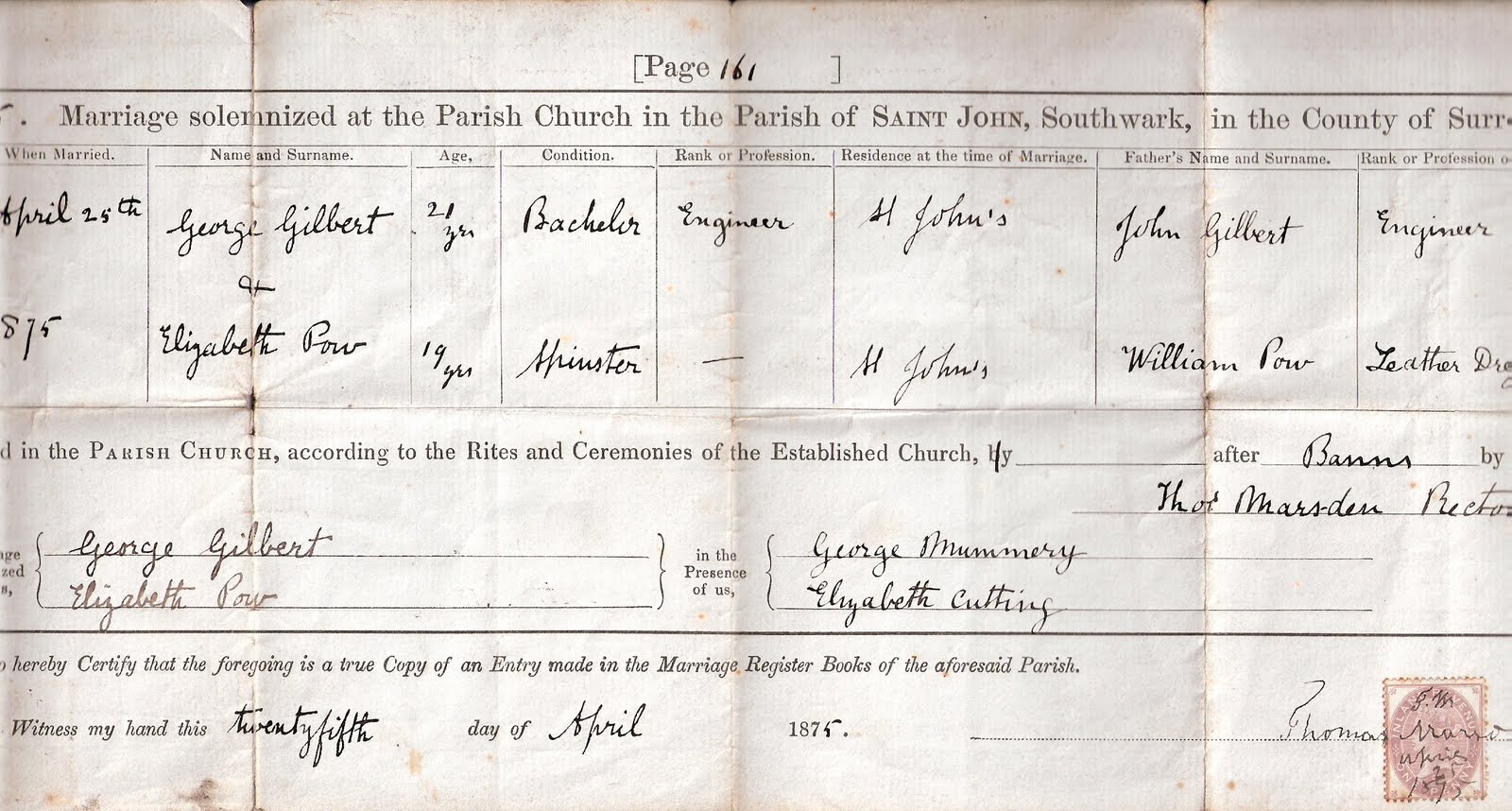


 George Fitzherbert and Elizabeth Pow's Marriage Certificate (1875)

Living with the In-Laws (The 1880s)

In 1881 and 1896, GEORGE FITZHERBERT (1854- ) is a Pottery Works Engine Driver – at marriage (1875) he was cited as an Engineer like his father (JOHN b1821) and on the birth of their first son two years later in 1877 he is cited as an Engine Fitter.

Elizabeth's parents William Pow and Ann Rebecca (nee Fudge) lived at 46 Raymouth Road from 1880 -1893, so Elizabeth was 'the girl next door' – ish!


We are not sure which pottery GEORGE FITZHERBERT (b1854) worked at as there were several in the area.  However, it could be the Doulton Works at Lambeth, due to a 3 inch (5.5 cm) jug inscribed with his name and the date 1887 that my father has.  This doesn't quite make sense however, and needs further research:

George would only have been 33 years old so the ornament wouldn't be for long-service (and married 12 years – the 9th anniversary is celebrated with pottery!) so it seems strange for him to be awarded a little jug, or as a driver, to have made it himself. I haven't seen anything in Doulton history on the web to indicate why this would be a special year to the factory either. Alternatively it could be from a member of another branch of the family – another little mystery maybe?


Just out of interest, Elizabeth's father was a leather dresser (and later her brother was a Tanner)  which fits in with the area they lived in;

“As crucial to the economy of Bermonsey as the river was the leather industry. The tanneries occupied much space south of the railway.” 7

GEORGE FITZHERBERT (1854-  ) and Elizabeth have 4 sons and one daughter. Just over 2 years after their marriage, the eldest (and my direct line) WILLIAM GEORGE was born on 16th May 1877 at 53 Silverlock Street, Rotherhithe. I think this is near Warndon St, just round the corner from Raymouth Road. Again it takes over a month to register the birth which was done by Elizabeth.


Four years later, by the 1881 census, GEORGE FITZHERBERT (1854- ), his wife Elizabeth, 2 of their children x and y are living at 46 Raymouth Road, Rotherhithe with Elizabeth's parents (in their 60s) and John Pow, (Elizabeth's brother aged 37 unmarried, unemployed and also born in Bermondsey). This makes a household of seven and I can only speculate whether it was through choice or hard times.


Within the next 10 years, Elizabeth's father William Pow has died. The 1891 census shows us the household still includes Ann Pow, now a widow aged 75 and John Pow, GEORGE FITZHERBERT's brother-in-law aged 47 who is now a Tanner.

By 1904,  GEORGE FITZHERBERT (1854) and Elizabeth have moved to 14 Poplar Road, Camberwell. This (and her age) probably indicates that Ann Pow is by now deceased. Maybe John Pow remained at Raymouth Road.  This would need to be investigated.


Poplar Road, Camberwell, South London

My grandad (ALBERT EDWARD (1904-1998) remembers having an uncle nicknamed 'Jumbo'. Indeed an elephant called Jumbo was brought for London Zoo by P. T. Barnam in 1882, so 'Jumbo' could conceivably be ALFRED (born about 1882). Grandad remembers his uncle Jumbo being a Stoker in the Royal Navy. I have looked at some ship's records but didn't find anything, however, this may still be traceable. His brother ARTHUR is remembered by grandad as being a "driver of a horse and cart".


ELIZABETH JANE (aka LILLIAN) married JOSEPH KING (1870-1931) a Draper's Collector in 1910. She would have been 24 years old. They had 6 children Katheryn (1912-1985), Joe (1914- ?), Nellie (1916-?), Len (1920-2002), Phyllis (1922-?) and Bernard (1924-1963). LILLIE who died in 1974 at Lewisham Hospital at the age of 61 8.


ELIZABETH POW died of tuberculosis on the 29th May 1904 at 14 Poplar Road in Camberwell. She was only 47 and her husband George was with her at her death. He would have been widowed at the age of 50.

Death Certificate of Elizabeth Pow (1904)


Third Generation Londoners (The 1890s)

Returning back to the eldest son, WILLIAM GEORGE (1877-1933);  he started his working life as a printer's machine boy (aged 14 circa 1891) but within five years had become a Stoker by trade.  For some unknown reason the marriage certificate states his name as WILLIAM JOHN when he marries SARAH ANNIE ROGERS on the 24th May 1896 in St Crispin's Church, Bermondsey.   It is undoubtably the same person.  WILLIAM (1877-1933) was 19 and Sarah was 18.


The marriage certificate of William and Sarah Annie Rogers 24th May 1896
(William George is now William John)


Sarah was given a Book of Common Prayer by the officiating minister which I still have.


From the marriage certificate we see that GEORGE FITZHERBERT (b1854) is still an Engine Driver though we don't know if that was still at the Pottery he was working at in 1881. Sarah Annie ROGERS (1878-1933) was living at 28 Southwark Park Road and her father Henry ROGERS was a Lighterman on the Thames.

There is a family story that Henry ROGERS fell into the Thames and drowned whilst working. Sarah's mother re-married a docker who regularly became drunk (family name ELLIS?). He would fall asleep at his meal so she would give his food to the children and tell him he had eaten it when he woke.


Mother of Sarah Annie Rogers circa 1900


 Sarah Annie Gilbert (nee Rogers) circa 1896
Thought to be at the time of her marriage in 1896 
by the wedding ring being clearly shown in the pose and from the clothes.


 Sarah Annie circa 1900
Probably a bit later – thinner face, leg o' mutton sleeves and lace cap(?)
– a style she is wearing in the family picture of about 1906


The Turn of the Century (The 1900s)

Sarah and WILLIAM GEORGE (1877-1933) had six children. I am descended from ALBERT EDWARD (1904-1998) their fifth child.


WILLIAM GEORGE (1877-1933) and Sarah Annie with five of their 6 children.

Far right: William George (1897-1916), next right Emily Grace (1898-1990)

Bottom row: on rocking horse, Albert Edward (1904-1998), Alfred Henry (1903-1974)  Sarah Annie (1878-1928), Lillian (1900-1974). Thomas (?-?) wasn't born yet, dating the picture at around 1906.

I was able to photocopy this picture just before it disintegrated – hence poor quality. Originally it was sepia, about A3 size and had been framed at one time.


SARAH ANNIE (1878-1928) circa 1910. This a home photograph, and the clothes seem later than those above, so the child she is holding may be Tom.


Footnotes:


1 how we work out John birthdate

2. 1841 Census

3. From the 1881 Census (Middlesex) we find a ROBERT GILBERT, Engine Fitter living at 8 Pundersons Gardens, Bethnal Green.  He is married to CATHERINE borth in North Roode who does somthing will bonnets (writing is unclear).  They are both 48 years old.  They have five children living with them; HELLEN, Furworker aged 17, SARAH, Trimmer aged 14, MINNIE, Scholar aged 11, ALICE, aged 9 and ROSE aged 5.


4. As shown on GEORGE FITZHERBERT's Birth Certificate, August 1854

5. Patent No 552 dated 12th September 1855 is An Improved Pump or Pumping Apparatus by John Gilbert of the Engine Works, Boston Street, Hackney.

6.  Stephen Humphrey (TBA)

7.  Leather (TBA)

8. Lillian King (TBA)

The First World War

The oldest child of WILLIAM GEORGE (1877-1933) and Sarah Annie (1878-1928) was WILLIAM GEORGE (1897-1916).  He was known as Willy1.
In 1901, the family were living in 4 Paradise Buildings, Paradise Street in Bermondsey, London.  By the next census on 2nd April 1911, WILLIAM GEORGE was assisting his father in the family Greengrocer business at 90 Keetons Road,  This shop is still on the corner of Jamaica Road [Location Map].


He worked as a Post Office messenger in the City of London from the age of 142.  

The First World War started (for the UK) on 4th August 1914.  WILLIAM (1897-1916) had started working for the Post Office in February 1915 and would be not only in a 'man's world' but, as a messenger, out and about the City of London hearing and receiving information about the war from all around him.


There wasn't any conscription until January 1916 when, because of the poor rates of volunteering (and high mortality rates), the UK Military Service Act was passed making single men aged 18 - 41 from non-reserved occupations, open to conscription.  From the back of a photograph, written in his mother's handwriting we now know that WILLIAM joined up on 3rd January 1916 enlisting in the 1/8 City of London Regiment - The Post Office Rifles.  He was 18 years old.

WILLIAM signed up with two of his best mates and fellow Post Office messengers.  His service number was 4873 with the rank of Private.  He was sent to France on 19th May 1916 after training and may have already been promoted to Lance Corporal at that time. His service record isn't available.

We know that WILLIAM (1897-1916) died at the Battle for the Butte-de-Warlencourt on 7th October 1916. 

WILLIAM may have seen his first action at the Battle of Vimy Ridge (22nd May 1916) when his regiment arrived at the Front. Though we do know that after Vimy Ridge, "Several drafts were received, both officers and other ranks."1 


The Post Office Rifles retired to billets at Camblain Chatelain ("which quickly became 'Charlie Chaplin.'"3) for three weeks until 11th June to rebuild with the new drafts and take part in morale building activities and it seems likely that this is where WILLIAM arrived.


Post Office Rifles date and location unknown.  
Commanding officer T Wright.
William is believed to be in the back row, third from the left.


The Battle of the Somme - High Wood and Beyond (September 1916)

The Battalion headed towards the front line on 11 June 1916, taking over the trenches in the Souchez sector to keep the Germans "pinned down 3".  The Post Office Rifles weren't involved in trench raids, 'only'  heavy artillery.
"As the June days wore on the tension increased.  All were aware of the impending Allied offensive to be mounted further south on the Somme, and hoped that the Division would be pulled out of the line in order to join the army of pursuit.....
News of what was actually going on in the south took a long time to percolate through to the PORs, and it was to be another month before they would start the long march south.  In the meantime, they left the Souchez sector on 15 July for another spell at Vimy, scene of the 21 May action.  Life here was somewhat quieter than before, although the Germans still held onto the craters.  Finally on 31 July the Division was relieved, and after a five-day march went into billets in the St Requier area for a final 'fattening up'.....
On 20 August the PORs were on the move again, as the Division now began its approach to the battle area.  The weather was extremely hot, and many men fell out, overcome by the heat.  As a result it was decided that from henceforth the day's march would start at dawn and end by midday when the sun was at its hottest....
Franvillers was reached on 23 August, and for the next three weeks, the Division prepared itself for its blooding on the Somme...

The Battle by this time had become one of attrition.... However, (Lt General) Haig was determined on another major effort at breakthrough, and by the end of August was convinced that the Germans had suffered sufficiently for success to be more than just possible.  There was, too, the fact that from late September the area was usually subject to several weeks of unsettled weather, and therefore the offensive must be mounted sooner rather than later.  The ultimate objective was to be Bapaume, and the basic plan was to establish a firm flank Morval to Bapaume and attack with all available troops centered on the Albert-Bapaume road.

The PORs spent their time training hard for the battle to come.  Officers visited the front line, and some also had a chance to have a preview of the tanks (a new weapon at that time). Much emphasis was placed on night operations, practicing night attacks and digging in as noiselessly as possible.  The weather was sill very hot, but with some rain, and the flies were everywhere.  There was also a good deal of minor sickness - mainly a form of summer 'flu, which left the victims feeling rather low for a few days.  The estaminets (inns) in the area were much frequented.
'Most of us turned over the very few francs and centimes that we happened to have and spent it. "Erfs" and "pomme de terre" were on sale plus plenty of "Plink Plong" - cheap red or white wine."

...in the early hours of 12 September, the Battalion left its billets for the last time and began its move forward......At 8.00am a bivouac area in Beaucourt Wood was reached.....For two days they waited here.  "No parades, no duties, just the, by now certain knowledge that we were not going to "hold down the line" but we were "going over the top".  Packs of well-worn cards were in demand for the many "schools".
... Finally during the afternoon of the fourteenth the order came to move forward to the assaulting positions..... Greatcoats and packs had been handed in, and dry rations, carried in a musette bag, issued.  Each man wore his gas mask rolled and stuffed into the front of his tunic.  He carried additional ammunition in bandoliers, two empty saddlebags for use in strengthening captured positions, a pick or shovel, and his entrenching tool.
....Zero hour was at 6.30am, and at the moment the Shiny Seventh (7th Battalion) went over the top without any preliminary bombardment, they met with heavy enemy fire, which drove them to ground with heavy casualties.  The PORs went into action shortly afterward .....Immediately they were met with intense machine gun fire.....In a few minutes three of the four assaulting company commanders... . were killed and the survivors had ..... gone to ground.

(By employing a huge battery of three inch Stokes mortar fire) " ....'the Jerry emplacements at last began to silence one by one.'....soon afterward, twenty or so Germans came over the open battlefield holding their hands up above their heads.  Within a short space of time the PORs had collected some 200 prisoners, and High Wood, after two months of furious effort had fallen....  During the next four days the PORs remained in action.  It took some time to sort out the confusion and attacks were mounted on positions which had already been captured...
The next three days were ones of furious local attacks and counter-attacks as the PORs strove to hang onto their positions in the Flers Line...... They managed to hold on, but it was an exhausting time for all, especially since the rain never ceased.  A survivor remembers it as  '...a nightmare between our artillery firing short and shrapnel from the German guns, while at night time everybody had to man the firestep and use our sodden and muddy rifles as best we could to repulse a counter-attack."
At last, just before dawn on the twentieth, they were relieved by a battalion of the Black Watch from the 1st Division.....the survivors made their way back into billets in Albert that night, and the next day marched a short distance to camp at Henencourt.  It was only here that it was possible for the first time to take stock of the casualties......The final bill was sixty-three killed, fifty missing, 185 wounded, or about a third of the Battalion's strength.  However, they had been luckier than the other three Battalions in the Brigade who lost far more.
It is also possible that WILLIAM GEORGE (1897-1916) and his two friends only joined the action at this time as I recollect my grandfather telling me WILLIAM was killed in his first battle.


William (on the right) and his two friends and Post Office work mates
(names, dates, location unknown, though a Rifleman Robert EDEN aged 19 died on the same day as William and had the next Serial number to him, so could be one of his friends).  
Remembered by family as joining the PORs together and dying together.


....But, again the reinforcement system worked well, and a large draft was received, although few officers, which brought the Battalion back up to strength.  There was, however, to be little time in which to absorb the newcomers, who "... were keen, but untrained in the very special methods the Somme fighting entailed.'"


The Battle of the Somme - Butte-de Warlencourt October 1916

"On 1 October orders were received to take over a bivouac area... in Mametz Wood....(after three days wait they spent one night back in the Flers Line) and then on the 6th October "orders were received to move into trenches in front of Eaucourt l'Abbaye in preparation for an attack the next day.... the objective was to be the Grid Line, a trench system which ran from Gueudecourt to Warlencourt.  Incorporated in the defense was the infamous Butte de Warlencourt, a prehistoric mound of excavated chalk, which rose sharply to a height of 70 feet, and still stands to this day.  The Germans had cunningly dug tunnels into it, constructing machine gun and observation posts, turning it into a veritable fortress.  Below the Butte lay a covering trench, Diagonal Trench, which had only recently been spotted, having been in dead ground until the system around Eaucourt l'Abbaye had been captured.  Diagonal Trench was to be the objective of the PORs, who would advance under a creeping barrage, the 7th and 15th Battalions passing through them to seize the portion of the Grid Line immediately to the right of the Butte.
At 1.45pm on the seventh the PORs once again went over the top.  Unfortunately the creeping barrage proved to be spluttery.... The inexperience of the new draft also manifested itself in a tendency to bunch and pay more attention to the shellfire rather than the enemy to the front.  As the leading companies breasted a slight rise, they noticed some bits of white rag tied to sticks in the ground, and passing through them triggered off intense machine gun fire from the Butte.
"There was not rattling roar of heavy and light field guns over our sector of the battle - only the fierce pattering of Jerry's machine guns cutting remorselessly at the handful of No 1 Company Post Office Rifles...I was bowled over, so were men on my left and right......"
The attack was halted in its tracks, and in no time at all the PORs had lost two-thirds of those engaged - forty killed, 160 wounded and 200 missing out of 650."

WILLIAM (1897-1916) was killed on 7th October 1916, aged 19, in one of the many disastrous and bloody battles of that stupid war. I checked the Battalion's war diaries at the War Records Office (grim, original notes handwritten in pencil) but the page for the day of the battle was missing - or maybe never written.

WILLIAM'S mother tried every way she could to find out what has happened to WILLIAM.  She refused to believe he was dead and, along with many other mothers met every train bringing troops back from France to London in the hope he would return.


WILLIAM (1897-1916) is buried in the War Graves Commission Cemetery at Warlencourt Cemetery.  He was initially buried in Hexham Road Cemetery or nearby4, as Warlencourt cemetery was designed by Sir Edwin Lutyens late in 1919 when the War Grave was created by bringing together the dead from small cemeteries and the battlefields of Warlencourt and Le Sars.


 I know WILLIAM (1897-1916) was highly regarded in the family. My grandfather, ALBERT (1904-1998) (who would have been about 11 years old when WILLIAM was killed) asked me not to talk about him when I found this all out in 1997. It still upset him. Grandad's birthday was Armistice Day so perhaps this made his loss more memorable.


Initially I knew nothing about my great-uncle from Grandad, only stumbling upon the story during my research. I was regularly going to the Post Office Museum in King Edward Street, London5, around the corner from where I worked, to while away winter lunch hours.  It wasn't until I saw a picture of the memorial in the former Post Office's lobby in a history book of the Post Office Rifles3 that I realised I had been walking past my great-uncles name each time I went there.


When I was given the family papers in 1997, a picture of the memorial appeared again with a letter to William's father dated 18th May 1920.

The timing would have been uncomfortable for his family as this would have been received a few days after WILLIAM GEORGE (1877-1933)'s birthday.


William's name is listed on bottom left under Lance Corporals 
and engraved on the monument itself.


The Monument in King Edwards Post Office Museum, London 
(now closed) (1997)


A short walk away, the Church of St Botolph at Aldersgate aka 'The Postman's Church',  holds a Book of Remembrance listing the Post Office Rifles who died serving their country.  WILLIAM (1897-1916) is listed there with the date September 1917.  I am not sure why that date would be there when he died in October 1916.


Post Office Rifle's area in St Botolph's Church (1997)


The inscription to WILLIAM (1897-1916) on his mother Sarah Annie (1878-1928)'s headstone also indicates that a least 10 years after the event, he was still, understandably, remembered.


WILLIAM GEORGE Snr (1877-1933) would have been 37 at the onset of the First World War. Maybe as a greengrocer his occupation prevented him for going to the war 6. I wonder how heavily that played upon his mind?  None of WILLIAM's male siblings were old enough to serve in the war and as far as I know none of his older nephews were in the war.


Footnotes
1. Book of Remembrance entry for Lillian Norman 27 Oct 1974, Honor Oak Crematorium, London SE23 and written by William's younger brother ALBERT EDWARD (1904-1988) states  '...sister of Willy,.....'

2. Post Office Archives, Appointment Record February 1915.  42151 Gilbert W. G., Learner (M) London


3.A History of the Post Office Rifles - 8th Battalion, City of London Regiment, 1914 to1918, The Naval & Military Press Ltd, Uckfield, UK, pages 11.13.


4."The only considerable burial ground moved into this cemetery was:- HEXHAM ROAD CEMETERY, LE SARS, on the West side of the Abbey grounds. (Hexham Road was the name given to the road leading from Warlencourt to Eaucourt. Le Sars was captured by the 23rd Division on the 7th October, 1916, and again by the Third Army on the 25th August, 1918.) This cemetery was used from November, 1916, to October, 1917, and contained the graves of 17 soldiers from the United Kingdom and 13 from Australia. 

The cemetery now contains 3,505 Commonwealth burials and commemorations of the First World War. 1,823 of the burials are unidentified but there are special memorials to 55 casualties known or believed to be buried among them. Other special memorials commemorate 15 casualties buried in Hexham Road Cemetery, whose graves were destroyed by shell fire.

Commonwealth War Graves Commission

 5. The Museum has since closed.  The memorial has been removed to St Albans.


6. Conscription for married men aged 17-51 was not law until April 1918.  WILLIAM GEORGE (1877-1993) would have been 40 years old.

Between the Wars

Since ?????? WILLIAM GEORGE (1877-1933) and Sarah Annie (1878-1928) and their six children had lived in Harders Rd, Peckham (Honor Oak Park), London SE23 and continued to live there, the house being passed down through the family for several generations.  As they grew up, the children stayed south of the river, moving further into Kent and Sussex, as they grew up and moved away to have families of their own.


The Other Children of William and Sarah Annie

 Emily Grace (1898-1990)


I clearly remember Auntie Em as a warm and friendly person and although I didn't see her very often, she always left a fond impression.

Born on the 3rd of October 1898 1 she was a year younger than the eldest child WILLIAM (1897-1916) and married Edward Stephen PLATT (1894-1988) - known as Ted - in the early 1920s.  She was always called Em.


Emily Grace circa 1906


Ted's birthday was on the 5th October, two days after Em's, making him three days short of being three years older than her. Ted's birth was registered in Rotherhithe, South London 2 like Em's was.


Em in 1920s, maybe around the time of her marriage to Ted.


Ted was a policeman, although my dad thinks he wasn't a 'bobby on the beat', but did something more 'exotic' in the force!  This picture is believed to have been taken in 1929.


Em and Ted had two children, Irene Marjory (known as Rene -pronounced Reenie) born circa 1924 and, Derek born on the 9th April 19263.  I have no recollections of Rene, but do remember Derek as a warm and generous person, and like Em and Ted did, remembered me on my birthday and at Christmas.  I believe has was a gardener.  Derek lived with his parents all his life, did not marry or have children.

They lived in London and then moved to Polegate, Sussex


Hand-coloured picture of Rene and Derek circa 1928


A day at the beach circa 1925 from L to R: 
William Gilbert (1977-1933), Sarah Annie Gilbert (1878-1928), Emily (1898-1990),
Joan (1923-2003) daughter of Alf (1903-1974),  
Ted Platt (1894-1988), Rene (b circa 1924)


Derek Platt died on 19th April 1985, ten days after his 59th birthday and before both his mother and father died.


Em died on the 16th March 1990 5 in Orpington (Kent) Hospital of bronchopneumonia aged 91 years old.


Ted had died in the same hospital 18 months earlier, aged 93, following a heart attack on the 15th September 1988 6.


 Lillian (1900-1974)


Lillian was the next child to be born.  She arrived on the 29th August 1900 7 in Camberwell.  Known as Lily, I saw her the most of all of that generation, apart from my grand-parents.  She was a regular guest at family teas and celebrations and used to pretend to read the tea-leaves.  Of course, as a child I didn't know she was pretending and was in awe of her powers of divination, not realising the information had been given to her earlier in the day!


Lily circa 1906


 Lily was a Shorthand Secretary and Typist for all her working life.


 Lily early 1920s


About 1923,  Lily married R. Norman and they had a daughter Josie.  But the marriage did not last, and Lily instigated divorce proceedings against him in 1933 8.  Divorce was unusual in those times carrying quite a stigma and I don't know how Lily managed as a single parent.


Lily and Josie circa 1925


Josie (also called Jo) was a very talented dancer from an early age.  She would have only been about 10 years old when her parents divorced.


Josie 1930

Josie also was a Shorthand Typist. She married George Edward Persson and they lived in Rectory Green, Beckenham, Kent. 9  I remember her having a problem with her legs and I think that contributed to her early death in the mid-1960s.  Josie was never forgotten and George was included in family events, even after re-marrying, remaining in Beckenham.


Josie 1945


Lily 1960s
Lily died on 27 October 1974 from heart failure.  She was 74 years old and living at Carhdue Road in Forest Hill SE23.  Her Will (1968) and handwritten note of her securities (1966) showed that she was comfortably off and shared her chattels around the wider family and her closest friends.

She had asked that she be cremated,  which was carried out on 4th November 1974 at Honor Oak Crematorium, Brockley Way SE4, and her ashes scattered on the family grave in the ajoining Camberwell New Cemetery 10.  An entry in the Book of Remembrance at the crematorium for 27 October 1974 says:

 NORMAN (nee GILBERT)  Lillian
1900-1974
Dearly loved mother of Jo, 
and much loved sister of Willy, Em, Alf , Albert and Tom. 


Alfred Henry (1903-1974)


Alf was born on16th January 1903.
I remember Alf as very handsome and charismatic but not that warm towards me.  I don't remember seeing him very often as I grew up.
Alf grew up with the others in Harders Road, Peckham, becoming the eldest living son at the age of 13 when WILLIAM (1897-1916) died.


At the age of 17 he was charged with playing cricket in the street to the annoyance of his neighbours.


Alf originally married Jenny and had a daughter Jean circa 1923. He was a Credit Trader - a business which I believe his father had passed onto him.

Jenny and Alf divorced and Jean went to live with her mother and was consequently disinherited by Alf 9.

Sometime later he married Mabel Forence (known as May).

Their first born was a son named WILLIAM GEORGE ROGER.  (It is with some relief for me in compiling this that he was known as ROGER.)  He married Barbara and had twin daughters Lynne and Kim.

JOAN IRIS was born in 1923.  She married Vic Horton and had Vivienne.


The cousins were very close in age in the 1920s and would regularly play together.


Alf was a really good artist painting mainly sea-scenes and his Christmas cards would be a photo of one of his latest paintings.


 Albert Edward (1904-1998)


 Thomas Joseph

Youngest
1947 - Rationing coupons have him at 86 Addington Road, West Wickham, Kent

Married Hilda May - William is still in phot0 so before 1933.  Jenny (alfs ex) in photo.  woman in back - dont think it is Sarah Annie - she died 1928.....

Picture of Tom on beach (see above with Rene and Joan).  He is a school boy around 12 years old and they are about 3-5 years old.


Adopted Peter Richard (known as Richard) on 26/3/1947.  He had been born on 18 / 4/ 1946 in Caversham, Reading

Richard was very intelligent (newspaper article).  gaiing 6 o'levels.  In 1971 aged 24 he was packing furniture in a Bermondsey factory and living in Pitcairn road, Mitcham (Daily Mirror., Saturday Jan 19th 1971) p5  Disappeared..... (when?) no contact ever since.


Sarah Annie (1878-1928) died aged 50 on 1st March 1928 of heart failure following influenza. She died at home - still 12 Harders Road, Peckham - and was buried on 21st March 1928.  She was interred at Camberwell New Cemetery in the Family Grave12


 WILLIAM GEORGE (1877-1933) died five years later on 1st September 1933 aged only 56, in Guy's Hospital, of complications following appendicitis. He was still working as an Engine Fitter and living at 12 Harders Road Peckham. My grandfather ALBERT (1904-1988), living at 8 Parbury Road, Peckham at the time, notified the Registrar of his father's death. The funeral was the same day as he died and he was interred in the family grave with his wife.


Nevertheless this WILLIAM GEORGE is not on the same headstone as his wife as sometime, probably in the five years after Sarah Annie died, an inscription to their son WILLIAM GEORGE (1900-1919) was added.


Footnotes
1.


(Note that William is cited once again as WILLIAM GEORGE.)

The Second World War

Stuff to be added here